 Los Angeles Real Estate Litigation Lawyer Jeffer Mangels & Mitchell LLP Home
Online sellers with California customers are increasingly receiving pre-suit demand letters from consumer class action firms like Pacific Trial Attorneys. The letters accuse the seller of “junk fee” or “drip pricing” violations of California’s Honest Pricing Law. The claim is that an advertised price left out a mandatory charge that appeared only later in checkout. The letters threaten a class action under the Consumers Legal Remedies Act (CLRA) unless the seller changes its pricing and refunds the fees.
A Typical Junk Fee Demand Letter:
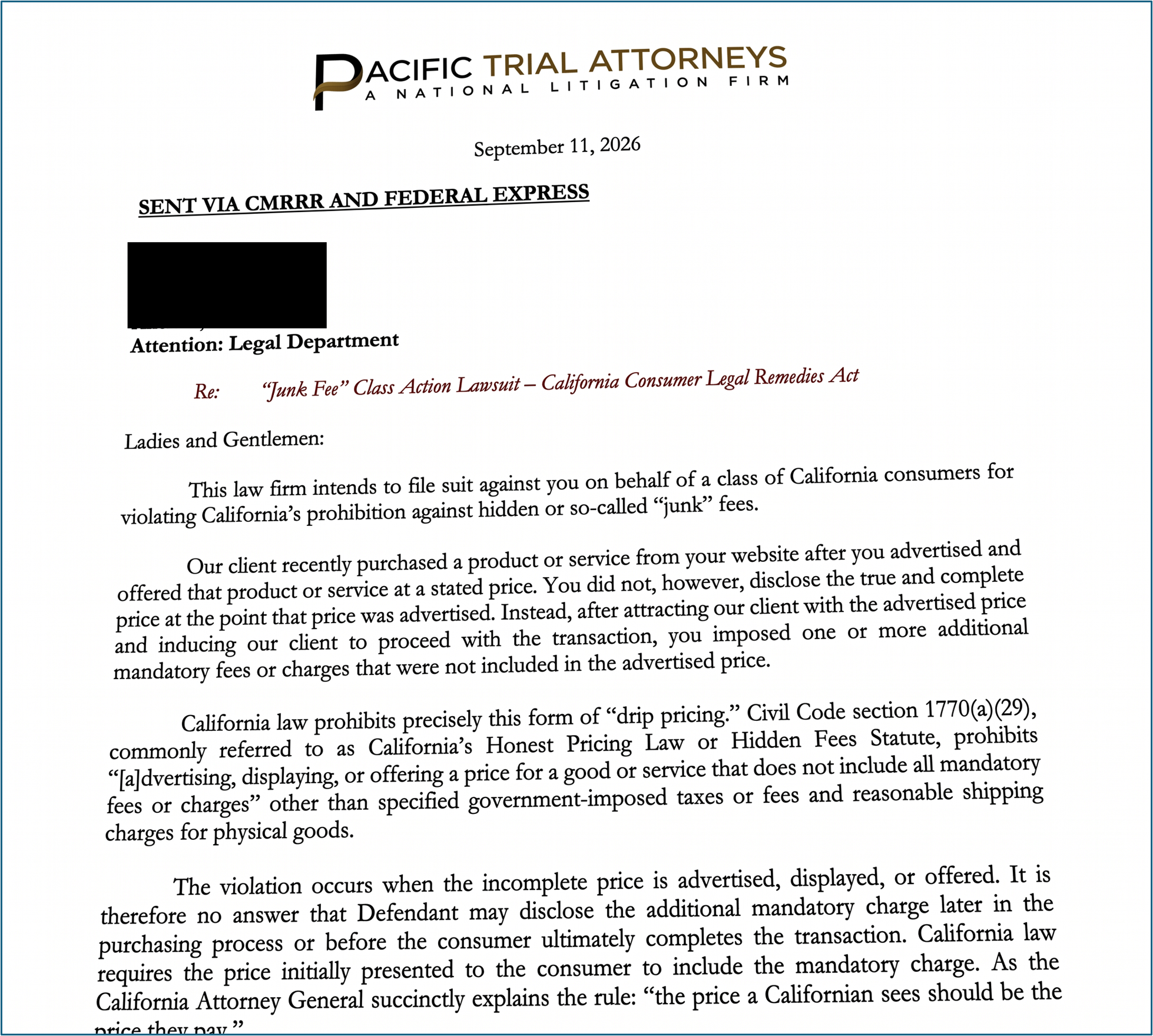
This sample letter is titled “‘Junk Fee’ Class Action Lawsuit – California Consumer Legal Remedies Act”. It states the firm’s client bought a product at an advertised price and was then charged additional mandatory fees. It cites Civil Code § 1770(a)(29) and demands that the seller stop the practice, revise its checkout so the first price shown includes all mandatory charges, and refund those fees to all California consumers. Page two invokes Civil Code § 1782 and gives the seller 30 days from receipt to correct the violations. The letter does not identify the client, the product, the purchase date, the price, or the fee.
The Honest Pricing Law
The Honest Pricing Law (SB 478) took effect July 1, 2024 and added subdivision (a)(29) to § 1770 of the CLRA. It prohibits advertising, displaying, or offering a price that leaves out mandatory fees or charges, other than taxes or fees imposed by a government on the transaction and postage or carriage charges reasonably and actually incurred to ship a physical good. The Attorney General describes it as a transparency law, not a price control law. A seller can charge what it likes and can itemize its fees, but the posted price must be the full amount the consumer must pay. SB 1524, signed June 29, 2024, carved out an exception for mandatory fees on food or beverage items sold by a restaurant, bar, food concession, grocery store, grocery delivery service, or under a banquet or catering contract, if the fee is clearly and conspicuously displayed with an explanation of its purpose. The carve-out does not cover third-party delivery platforms.
The Attorney General’s FAQ shows where sellers get into trouble. Disclosing the fee before the consumer completes the purchase does not cure the problem, and neither does advertising one price and noting that a percentage or variable service fee will follow. Sellers may exclude actual shipping charges but not handling charges. Optional fees, and fees that depend on the consumer’s later conduct, are not mandatory. A credit card fee the customer can avoid by paying another way is a reasonable candidate for the same treatment, but that point is not in the FAQ. The FAQ is guidance and does not bind the courts.
Because the provision sits inside the CLRA, its remedies come with it. Consumers may recover actual damages, and in a class action the total damages award may not be less than $1,000. (Cal. Civ. Code § 1780(a)(1).) Plaintiffs can also seek an injunction, restitution, punitive damages, and any other relief the court deems proper. (Id. § 1780(a)(2)–(5).) A prevailing plaintiff must be awarded fees and costs, while a prevailing defendant can recover fees only if the court finds the plaintiff’s prosecution of the action was not in good faith. (Id. § 1780(e).) That imbalance drives much of the settlement pressure these letters create.
What the Courts Are Saying
Two Northern District of California decisions show how the law is developing. In Chowning v. Tyler Technologies, Inc., No. 4:25-cv-04009-YGR (N.D. Cal. Dec. 5, 2025), plaintiffs challenged an $8.25 reservation fee that appeared only near the end of a campsite booking flow on the ReserveCalifornia state parks site. Judge Gonzalez Rogers denied the motion to dismiss as to the CLRA claim. The court held that paying a late-disclosed fee is an injury, that the Legislature’s ban supports materiality, and that the exemption for government-imposed fees is read narrowly.
Heilman v. Abercrombie & Fitch Co., No. 3:26-cv-02224-EMC (N.D. Cal. July 29, 2026), went the other way. Judge Chen dismissed a challenge to a $7 shipping and handling fee because the customer could have avoided it by choosing free in-store pickup. The court rejected the argument that a fee is never mandatory because a consumer could shop elsewhere. It left open whether a fee could still be mandatory if the alternative is impractical, such as when the nearest store is too far away. The dismissal was without prejudice.
“Mandatory” will likely be the main battleground. A free, reasonably accessible alternative is a real defense, while the argument that the buyer saw the final price and went ahead anyway did not get far in Chowning.
Defenses and Leverage Points
The first question is whether the charge is actually mandatory. If customers can avoid it, or it is triggered only by later conduct, the claim is weak. The statutory exclusions matter too. Real shipping costs and government taxes can stay out of the advertised price, but anything labeled “shipping” that looks like handling will draw a challenge.
Next, examine the § 1782 notice. To seek damages, the consumer must give written notice of the particular alleged violations and demand correction at least 30 days before filing. (Cal. Civ. Code § 1782(a).) The notice must go by certified or registered mail, return receipt requested, to the place of the transaction or the business’s principal place of business in California.
The notice provision is also where the cure opportunities lie. For an individual claim, damages are barred if, within 30 days of receipt, the business gives an appropriate remedy or agrees to give it within a reasonable time. (Cal. Civ. Code § 1782(b).) For a class, the business must show that it identified (or reasonably tried to identify) similarly situated consumers, notified them that they can request the remedy, has provided or will provide it within a reasonable time, and has stopped or will stop the practice within a reasonable time. (Id. § 1782(c).) A separate provision bars damages for an unintentional bona fide error despite reasonable procedures, but only if the business also provides the § 1782 remedy. (Id. § 1784.) Attempts to comply with a demand are treated as inadmissible offers to compromise, not admissions.
Other defenses depend on the facts, such as challenges to class action status.
What to Do if You Receive a Letter
The 30 days run from receipt, so note the delivery date on the certified mail receipt and read the letter for inconsistencies. Then move quickly:
- Preserve the checkout flow on desktop and mobile, earlier versions of the site, and the order records. If you fix the site, preserve the existing configuration first.
- Identify the fee at issue, what triggers it, whether customers can avoid it, and what price appears at each step.
- Quantify California exposure. CLRA claims must be brought within three years of the challenged practice. (Cal. Civ. Code § 1783.) Because subdivision (a)(29) took effect July 1, 2024, Honest Pricing Law claims cannot reach purchases before that date, even if the three-year window would otherwise go back further.
- Consider displaying an all-in price going forward, which stops the exposure from growing and supports any § 1782 cure.
- Speak with your attorney and decide whether to cure, settle, or defend. An individual resolution usually will not bind other consumers, while a cure that meets every § 1782(c) element can bar class damages.
For legal help with a “junk fee,” drip pricing, or similar CLRA demand letter, contact Stuart K. Tubis, Esq. at skt@jeffer.com or 415-984-9622.


 Your Privacy Choices