 Los Angeles Real Estate Litigation Lawyer Jeffer Mangels & Mitchell LLP Home
California businesses offering subscription services, from skincare products to online memberships, are increasingly finding themselves in the crosshairs of class action lawsuits alleging violations of the state’s Automatic Renewal Law (ARL). Enacted in 2010 and codified in California Business & Professions Code §§ 17600-17606, the ARL was designed to protect consumers from unauthorized recurring charges by requiring clear disclosures, affirmative consent, and easy cancellation options. However, it has also become a fertile ground for serial litigation, much like the serial ADA and Unruh Civil Rights Act lawsuits we’ve discussed in previous articles.
Firms like Pacific Trial Attorneys, based in Newport Beach and led by attorneys such as Scott J. Ferrell and Victoria C. Knowles, have been particularly active in this space. They represent plaintiffs in numerous ARL cases, often filing on behalf of repeat plaintiffs who challenge companies’ subscription practices. For example, Luis Licea has been named as a plaintiff or potential plaintiff on behalf of similarly situated individuals against various businesses in class action complaints filed in Los Angeles County Superior Court or threatened to be filed. Licea alleges that the company’s auto-renewing subscription for products violated the ARL by failing to provide “clear and conspicuous” disclosures of renewal terms, an incomplete cancellation policy, and inadequate post-purchase acknowledgments.
If your business sells products or services via auto-renewing subscriptions to California consumers, understanding this law is critical to avoiding costly litigation. Below is a breakdown of the key elements of the ARL, common pitfalls, and practical steps for defense and compliance.
What Is California’s Automatic Renewal Law?
The ARL applies to any business making an “automatic renewal” or “continuous service” offer to California consumers. This includes plans where a subscription renews automatically after a definite term (e.g., monthly beauty boxes) or converts from a free trial to paid without explicit action. The law’s intent is straightforward: end “gotcha” tactics where consumers are hit with ongoing charges without their informed consent (Cal. Bus. & Prof. Code § 17600).
Under § 17602, businesses must comply with three core requirements:
- Pre-Purchase Disclosures: Before obtaining consent, present the automatic renewal terms “in a clear and conspicuous manner” (larger type, contrasting font/color, or set off by symbols—think bold, underlined text that stands out, not buried in fine print ) and in “visual proximity” to the consent request. Terms must include:
- That the subscription continues until canceled.
- The cancellation policy.
- Recurring charges (and any potential changes).
- The renewal term length (or that it’s continuous).
- Any minimum purchase obligation.
(Cal. Bus. & Prof. Code § 17601(c)
- Affirmative Consent: You can’t charge without the consumer’s explicit agreement to the terms. No pre-checked boxes or assumptions.
- Post-Purchase Acknowledgment: Send a retainable confirmation (e.g., email) repeating the terms, cancellation policy, and how to cancel (toll-free number, email, or easy online method). For free trials, include cancellation instructions before payment.
Violations often trigger claims under related statutes, including the Consumers Legal Remedies Act (CLRA, Cal. Civ. Code § 1750 et seq.), Unfair Competition Law (UCL, Cal. Bus. & Prof. Code § 17200 et seq.), and False Advertising Law (FAL, Cal. Bus. & Prof. Code § 17500 et seq.). Remedies can include restitution of all charges (deemed “unconditional gifts” under § 17603), statutory damages (up to $1,000 per violation under CLRA), injunctive relief, and plaintiffs’ attorneys’ fees—potentially escalating a single subscription dispute into a multimillion-dollar class action.
Common Violations and Lessons from Recent Cases
Plaintiffs target perceived weaknesses in website designs and email confirmations. For example, the complaint might allege:
- Checkout page disclosures in small, gray font, overshadowed by larger elements like the “Pay Now” button.
- A hyperlinked “cancellation policy” that is vague and incomplete, directing users to email without actual links or clear steps.
- Confirmation emails lacking full terms or easy cancellation info.
An example complaint is shown below:
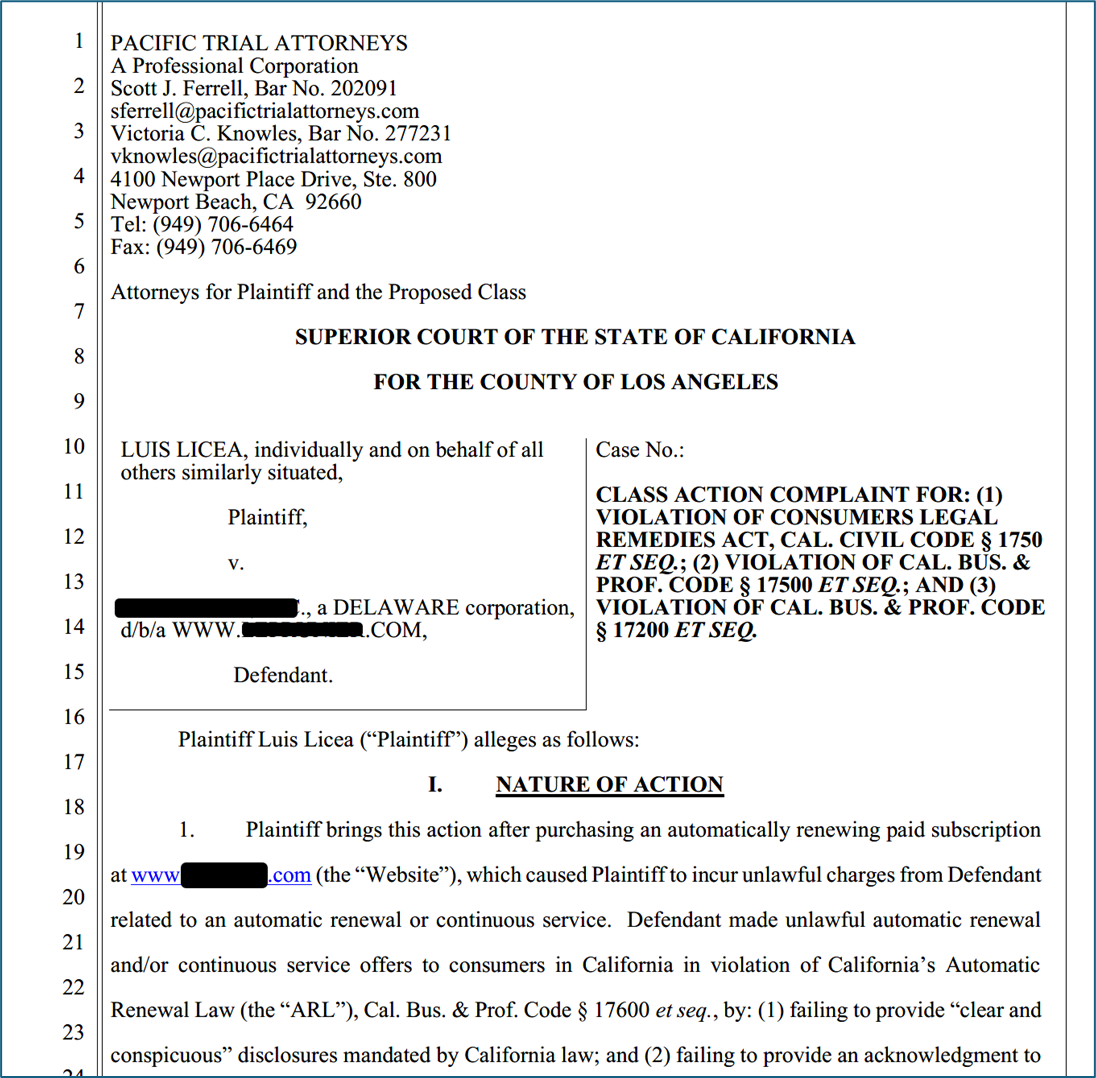
Courts have upheld strict interpretations, and businesses lose when terms “blend in” or require excessive effort to find.
Jurisdiction is another hook—companies outside California can be sued if they generate meaningful revenue from Californians, equating to a “physical store” under case law like Thurston v. Fairfield Collectibles (2020).
What Businesses Need to Know: Compliance and Defense Strategies
If your company offers subscriptions, treat ARL compliance like ADA website accessibility: proactive measures save money. Here’s what potential defendants should prioritize:
- Audit Your Website and Flows: Engage legal counsel or accessibility experts to review checkout pages. Ensure disclosures are prominent—use contrasting colors, larger fonts (at least 12-14 point), and place them directly above the consent button. Avoid hyperlinks that hide key details; spell out cancellation steps clearly (e.g., “Log in > Manage Subscriptions > Cancel”).
- Streamline Cancellations: Provide multiple easy methods (phone, email, online portal). In many cases, the plaintiffs alleged the process requires multiple confirmations, frustrating users—so make it one-click where possible.
- Perfect Confirmations: Emails should mirror pre-purchase terms verbatim. Include a direct cancellation link to avoid claims of non-retainability.
- If Sued: Don’t ignore demand letters from firms like Pacific Trial Attorneys—these often precede filings. Early investigation can reveal defenses, such as:
- Lack of injury (if the plaintiff knew about the renewal).
- Compliance with ARL (e.g., terms were conspicuous per Ninth Circuit standards).
- Arbitration clauses or class action waivers in terms of service.
In some cases, like ADA defenses, attorneys’ fees can be secured for prevailing defendants (see our post on Garcia v. Zarco Hotels). While rarer in ARL, strong facts can lead to dismissals or settlements on favorable terms.
California’s consumer laws, including ARL, emphasize transparency to build trust—non-compliance not only invites lawsuits but erodes customer loyalty.
For help with an ARL lawsuits or other legal matters, contact attorney Stuart K. Tubis, Esq. at stubis@jeffer.com or 415-984-9622.


 Your Privacy Choices